“How much chewing gum do Americans buy in a year?” Questions like this decide first rounds at consulting, strategy and tech firms. This course teaches you one method that works for every one of them, then drills it on 33 fully solved cases.
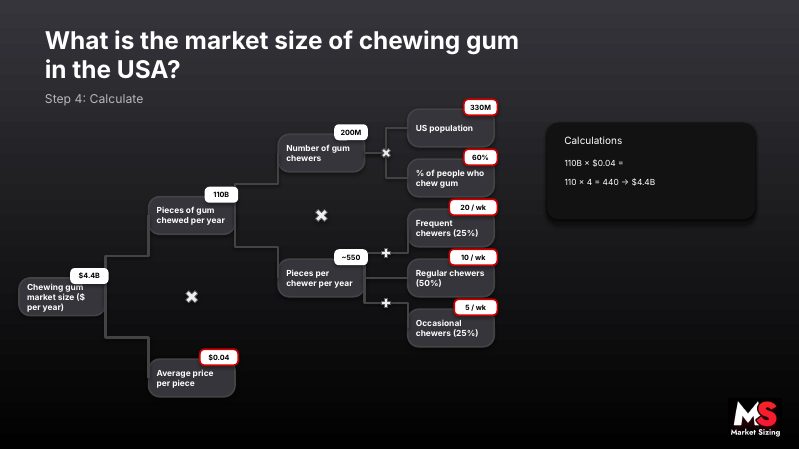
What is the market size of chewing gum in the USA?
Sanity check: about $13 per person per year, roughly one pack a month.
Estimation questions come up far beyond consulting.
Interviewers do not score the final number. They score how you got there. These five steps make your thinking easy to follow, every time, in the same order.
Clarify scope before you start, so you never solve the wrong question.
“Are we sizing retail value or manufacturer revenue?”
Say your plan in one or two sentences and check that it sounds right.
“I will start from the number of people who chew gum…”
Draw the logic from left to right, starting from the output, before any numbers.
Market = pieces × price
Put a number on each leaf, explain why, then round your way to the answer.
330 × 0.6 ≈ 200M
Test the answer against something you know before you present it.
$4.4B ÷ 330M ≈ $13 a head
▶Chewing gum in the USA · free lesson
About 90% of estimation questions fit one of five types. Each one has a standard tree you can draw in the first minute.
Things people use up and buy again.
Lipstick in the USA · Takeaway coffee in Moscow
Durable goods people replace every few years.
Smartphones in Brazil · Refrigerators in Italy
How many shops, vehicles or people serve a market.
Barbers in London · Yellow cabs in New York
How many things fit in a space, or happen in a place.
Golf balls in a Boeing 737 · Trees saved by the Kindle
Revenue, cost and profit of a single business.
Revenue of a Starbucks store · Airbnb's annual revenue
Lesson 3 teaches you how to tell from the key words in the question, and how to handle hybrid cases.
See the curriculumFive theory lessons give you the method and the toolkit. Then 33 cases, each solved step by step on screen with a pause to try it yourself first.
I am Askar Gabzhalilov, an Associate Director at Interpath in London. For ten years I have worked at KPMG, FTI Consulting, Efficio and now Interpath, on M&A deals, turnarounds and transformation programmes for FMCG, healthcare, technology and private equity clients.
On almost every one of those projects, the first useful answer was a quick, structured estimate. Before any model is built, someone has to say how big the market is, how much a fix is worth, or whether an idea is worth testing at all.
I have also taught for as long as I have worked. I have mentored students at SEO London since 2016, tutored economics and finance for more than 250 hours, and prepared candidates who went on to join MBB firms. This course is the method I use with them: one clear process, lots of solved cases, and the habit of thinking out loud.
Watch the first five lessons for free. If the method works for you, unlock everything with one payment and lifetime access. Launch offer: every paid plan is 50% off.
Book a live session to run market sizing and case questions under interview conditions, and get direct feedback on your structure, maths and delivery. I have prepared candidates who went on to join MBB firms, and I have run CV clinics for Warwick students.
Tell me your target firms, your interview dates and what you want to work on.
No. The course uses school-level maths and teaches the rounding tricks you need to calculate quickly and out loud.
No. Strategy, banking, product and tech roles ask the same questions, and the method works the same way.
The theory takes about an evening. Most students then work through two or three cases a day for one to two weeks before interviews.
There is rarely one right number. You will learn to reach a sensible answer with clear logic, which is what interviewers score.